Cold Front- Fast moving cold air blows in and pushes the warm air up and cools it. It forms cumulonimbus and cumulus clouds. If there is a lot of water vapor in the clouds then thunderstorms may occur.
Warm Front- Slow moving warm air blows in and collides with slow moving cool air. The warm air rises and forms clouds. If water vapor is present, precipitation may occur.
Stationary Front- A warm air mass and a cool air mass meet, but neither one has enough force to push the other. Huge, high towering clouds form.
Occluded Front- A warm air mass is caught between two cool air masses and is pushed upwards. The cool air masses mix and cause cool temperatures. If water vapor is present, clouds are formed.
Which type of front occurred this week to bring the cold weather and then snow? A cold front
Friday, December 5, 2008

Tuesday, December 2, 2008

Thursday, November 20, 2008
Havana, Cuba (20N) to London, England (55N)
Travel time: 9 days
Direction traveling: NE, E
Were you successful? yes
How many attempts? 1
What winds did you take advantage of or compete with during your travel? I didn't compete against any winds. I basically used the northern blowing prevailing westerlies to get me there!
Direction traveling: NE, E
Were you successful? yes
How many attempts? 1
What winds did you take advantage of or compete with during your travel? I didn't compete against any winds. I basically used the northern blowing prevailing westerlies to get me there!
San, Francisco US (35N) to Sydney, Australia (35S)
Travel time: 13 days
Direction traveling: SW only
Were you successful? yes
How many attempts? 1
What winds did you take advantage of or compete with during your travel? I competed with the northern blowing prevailing westerlies and the northern blowing trade winds. I used the southern blowing prevailing westerlies and the southern blowing trade winds to my advantage.
Direction traveling: SW only
Were you successful? yes
How many attempts? 1
What winds did you take advantage of or compete with during your travel? I competed with the northern blowing prevailing westerlies and the northern blowing trade winds. I used the southern blowing prevailing westerlies and the southern blowing trade winds to my advantage.
Tuesday, November 18, 2008
Thursday, November 6, 2008
Earth Compared to Other Planets
Since Earth has an atmosphere it does lots of things to protect us. One thing it does is keep big meteors from hitting the surface. The mososphere is the layer of the atmosphere that protects us from large meteors, because meteors burn up there. On other planets without atmospheres, meteors just hit the planet and create craters. The stratosphere protects us from ultra violet rays from the sun. The ozone layer is what protects us. On other planets rays shine directly onto the planets surface causing extreme temperatures. The atmosphere also keeps heat out and traps other heat in. On planets without atmospheres, sun rays only heat the lit side of the planet. The atmosphere also creates weather. Weather occurs in the troposphere. On other planets without atmospheres, weather can't occur, because clouds aren't present.
Wednesday, November 5, 2008
London Type Smog
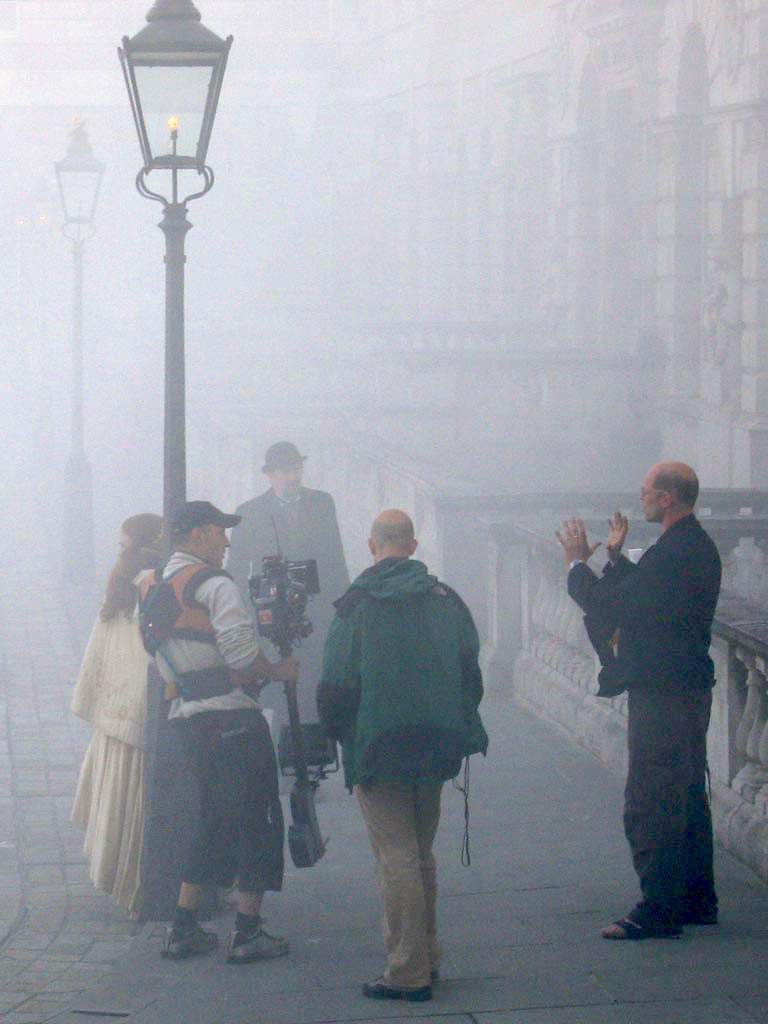
London type smog is the polluted air that once surrounded London about 100 years ago. The cause of this smog was the burning of coal. The particles in the smoke from the burning coal mixed with the moisture in the air and created "smog". The consequences of the smog were that the air was very black and people were getting sick from inhaling it. The main thing that people did and still do today is stop burning so much coal or not burn any at all.
Wednesday, October 8, 2008

Monday, September 29, 2008
Monday, September 22, 2008
Friday, September 19, 2008
Gizmo Seasons
The main factor that causes seasons is Earth's tilt. When the Earth is tilted away from the sun, the Southern Hemisphere receives the most direct sunlight, and is in summer. When the Earth is tilted towards the sun, the Northern Hemisphere receives the most sunlight, and is in summer. Another factor that causes seasons is earth's revolution. When the earth revolves, the hemispheres are facing the sun in different ways. For example, when its summer in Colorado, the Northern Hemishere is recieving the most direct sunlight, because at that point, the north is tilted toward the sun.
Monday, September 15, 2008
Zoom Perspective
The book Zoom took a "picture" of a SMALL part of the world and kept zooming out from it until it got to outer space. Every time you turn the page, you could guess or infer what you were looking at. This is related to perspective, because you can have a different view or idea on what you are looking at (a.k.a. the page). Everyone has a different view or prospective on what the page is showing.
Sometimes, I think I am viewing or seeing something correctly, but it turns out I have a bad prospective on it. If I get a different prospective on the subject, I can sometimes change my mind. Mindset, where I'm standing, and previous occurrences can all change my prospective on things.
In science anyone can be interested in my gathered data. For example, scientist could use my data for further research, or other people could use my data to make their own ideas. Scientists would probably be more interested in close-up data, where as to other people just want the overall view of things. When we study astronomy, prospective is very important, because depending on where and when you are, your prospective will change, because things in space are constantly moving.
Sometimes, I think I am viewing or seeing something correctly, but it turns out I have a bad prospective on it. If I get a different prospective on the subject, I can sometimes change my mind. Mindset, where I'm standing, and previous occurrences can all change my prospective on things.
In science anyone can be interested in my gathered data. For example, scientist could use my data for further research, or other people could use my data to make their own ideas. Scientists would probably be more interested in close-up data, where as to other people just want the overall view of things. When we study astronomy, prospective is very important, because depending on where and when you are, your prospective will change, because things in space are constantly moving.
Friday, August 29, 2008
Enigma Box
While observing the enigma box, I noticed that once all 450 liters of water were poured in, it all started 2 gush out. Secondly, i noticed that during the whole time, the tube dripped drops of water. Next, I observed that I could hear the water filling up in the box after the 1st pitcher of water. Finally, I observed that
I think that in the inside of the enigma box, the tube is layed sideways with a tiny "plug" in it. I think that once enough water gets into the box, the pressure pushes the plug aside, and it all rushes past. This would explain why water slowly drips throughout the whole process. The "plug" can't hold ALL of the water, so it slowly leaks by.
What was actually going on inside of the box was simple!! The tube was wrapped in a circle around the inside of the box. It starts with the open end of the tube face-down at the bottom of the box. The tube then moves upwards and loops around back to the bottom of the box. The other open end of the tube is fed outside of the box. Once enough water was poured in to fill the tube to the top, it ran back down the loop of the tube and out the side. The air pressure inside pushed the rest of the water out.
I think that in the inside of the enigma box, the tube is layed sideways with a tiny "plug" in it. I think that once enough water gets into the box, the pressure pushes the plug aside, and it all rushes past. This would explain why water slowly drips throughout the whole process. The "plug" can't hold ALL of the water, so it slowly leaks by.
What was actually going on inside of the box was simple!! The tube was wrapped in a circle around the inside of the box. It starts with the open end of the tube face-down at the bottom of the box. The tube then moves upwards and loops around back to the bottom of the box. The other open end of the tube is fed outside of the box. Once enough water was poured in to fill the tube to the top, it ran back down the loop of the tube and out the side. The air pressure inside pushed the rest of the water out.
Subscribe to:
Posts (Atom)